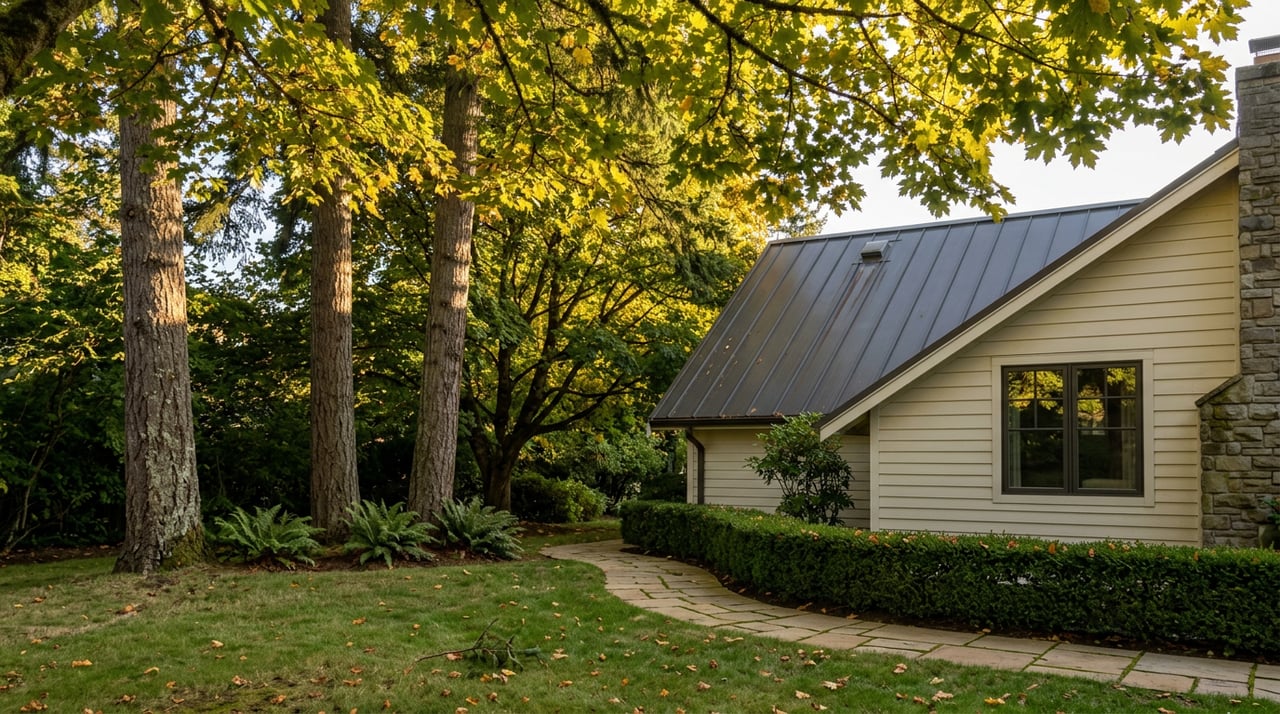
A buyer tours a 1962 rambler in Eastgate. The house itself is unremarkable, but the lot is the draw: nearly 10,000 square feet, gently sloped, three mature Douglas firs and a big-leaf maple along the back fence. The plan takes shape on the drive home. Tear down, build new, keep the trees for shade and privacy in the renderings.
That plan gets more complicated the moment a permit application touches Bellevue's Land Use Code. The rules governing what happens to those trees changed substantially in 2024, and the city has kept amending them since, most recently through two ordinances codified earlier this year. For a straightforward remodel, none of this matters much. For a teardown on an older, treed lot in Eastgate, Enatai, Sherwood Forest, Lake Hills, or Bridle Trails, it can change what the lot is actually worth to you.
What changed, and why it matters now
On July 9, 2024, Bellevue's City Council adopted the first major overhaul of its tree ordinances in more than 40 years, with the new rules taking effect on August 10 of that year. The city has revisited the code twice more since. Ordinance 6894 was codified in April 2026, and Ordinance 6906 followed in May 2026, both amending the tree retention and replacement section of the Land Use Code along with related provisions on dimensional requirements and landscaping.
The overhaul was a response to something the city could measure. Residential tree canopy fell 6.5 percent between 2019 and 2021, with the losses concentrated in neighborhoods where older mid-century houses were being replaced by homes often more than double the previous size, and where builders removed most or all of the trees on a lot during construction. Eastgate, Enatai, and Sherwood Forest were named specifically as places where that pattern showed up hardest.
The credit system that decides whether keeping a tree pays off
The mechanism doing the real work in the new code is a credit system. Every redevelopment project has to hit a minimum tree density, calculated per 1,000 square feet of lot area and set by zoning. A 7,500 square foot lot zoned for a duplex, for example, needs 1.5 tree credits per 1,000 square feet, or 11 credits total.
Where it gets interesting is how you're allowed to hit that number. A newly planted tree earns one credit. An existing significant tree, meaning 6 inches or larger in diameter, is worth more depending on size, with a 12-inch tree valued at 4 credits. A landmark tree, defined as 24 inches or larger in diameter (with some slow-growing natives like Pacific madrone and Garry oak qualifying at smaller sizes), is worth 10 credits on its own.
| Tree status | Diameter | Credit value |
|---|---|---|
| Newly planted tree | Any | 1 credit |
| Significant tree (existing) | 6" or larger | Scales with diameter, a 12" tree earns 4 |
| Landmark tree (existing) | 24" or larger | 10 credits |
On that 11-credit lot, keeping one landmark tree and one smaller significant tree gets you there. Starting from a cleared site means finding room for 11 new trees on a lot that just had a house built on it, plus a multi-year maintenance bond the city can require to confirm those saplings survive.
That is the part of the math a listing photo never shows. A property with two or three genuinely mature trees on it isn't just a nicer lot to look at. It's a lot where meeting the city's density requirement is close to free. A cleared or sparsely planted lot of the same square footage means budgeting for an entire planting plan on top of construction.
The three-year lookback nobody budgets for
Bellevue's code also looks backward. If trees were removed from a property in the three years before a redevelopment application is submitted, the code treats them as though they were still there when calculating required density.
A lot advertised as "already cleared and ready to build" can still carry a tree credit obligation if that clearing happened within the last three years.
This is worth asking about directly during due diligence rather than assuming. If a seller or their agent describes a lot as conveniently prepped for construction, find out when the clearing happened and whether it was permitted. A recent removal, especially one done without a permit, can turn what looked like a simplified project into one that still owes the city tree credits on top of whatever penalty applies to the earlier work. City guidance is blunt about this: a "we didn't know" defense rarely holds up, particularly given how publicized the code update was.
Landmark trees cost more to take down than people expect
Even when removal is the right call and the permit clears, landmark trees aren't a same-day chainsaw job. Removing one requires a Washington State licensed contractor, and the work is often done as a sectional dismantling from the canopy down rather than a single felling, particularly on lots with structures, fences, or neighbors close by. That's a meaningfully different cost and timeline than clearing a row of smaller volunteer trees, and it's easy to underestimate if your only removal experience comes from a less treed property.
Applications for tree removal, like most permits in Bellevue, run through MyBuildingPermit.com, the regional portal shared with several Eastside cities. A straightforward residential removal can clear that system in a couple of weeks. Anything touching critical areas, buffers, or a full redevelopment review takes considerably longer, which matters if a construction loan or a rate lock is running on a clock.
Bridle Trails buyers, the old exemption is gone
Anyone who bought in Bridle Trails specifically because of its historically looser tree rules should know that separate standard no longer exists. The neighborhood previously operated under its own tree provisions, distinct from the rest of the city. The 2024 update folded it into the same citywide rules everyone else follows. A lot there that might have supported a more aggressive clearing plan under the old standards doesn't get that treatment now.
What to check before writing an offer
None of this argues against buying an older home on a treed lot in Bellevue. It argues for pricing the trees into an offer the same way you'd price a foundation issue or an outdated panel, as a variable that changes what comes next.
Before making an offer on a property you're planning to redevelop, it's worth confirming:
- How many significant and landmark trees are actually on the lot, ideally from an arborist survey rather than a drive-by estimate
- Whether any trees were removed from the property in the past three years, and whether that removal was permitted
- The required tree density for your target zoning and lot size, and how many of those credits the existing trees already satisfy
- Whether mature trees sit near property lines, structures, or the right-of-way, since that affects whether removal requires the more involved sectional process
- Current timelines through MyBuildingPermit.com for the specific permit your project needs, since a simple removal and a full redevelopment review move at very different speeds
A lot that looks like it needs more site work than a competing listing can turn out to be the cheaper build once the tree math is done, and the reverse holds just as often.
FAQ
Does this apply if I'm building on a lot with no existing trees? The density requirement still applies regardless of what's currently there. An owner starting with very few trees has to plant enough new ones to meet the minimum, while an owner with a high number of existing mature trees has more flexibility to remove some.
Do Mercer Island or Seattle use the same tree rules as Bellevue? No. Each city sets its own code, and Bellevue's thresholds and density formula apply only within Bellevue city limits. If you're comparing a Bellevue teardown lot against a similar one across a city line, don't assume the numbers transfer.
Is there a faster or cheaper permit path for a smaller residential project? The city has signaled a lower-cost permit type for limited residential removals is coming, intended for simpler homeowner projects rather than full redevelopment. It hasn't been confirmed as available yet, so it's worth checking current options with Development Services before assuming a shortcut applies.
If you're weighing an older Bellevue property against its redevelopment potential, the tree math is worth running before the offer, not after inspection. Michael Fleming has spent years reading Eastside lots for exactly this kind of detail. Let's connect and look at what a specific property's trees actually mean for your plans.